
Zhichao AI Overview
Zhichao AI is a collection of AI capabilities built by BabelBird Enterprise Drive around enterprise documents, knowledge base, search, customer service and data analysis. It is not an isolated chat tool, but is combined with Babel's file storage, permission system, search engine, material library, project collaboration, online preview and private deployment capabilities to allow AI to work on the company's existing data.
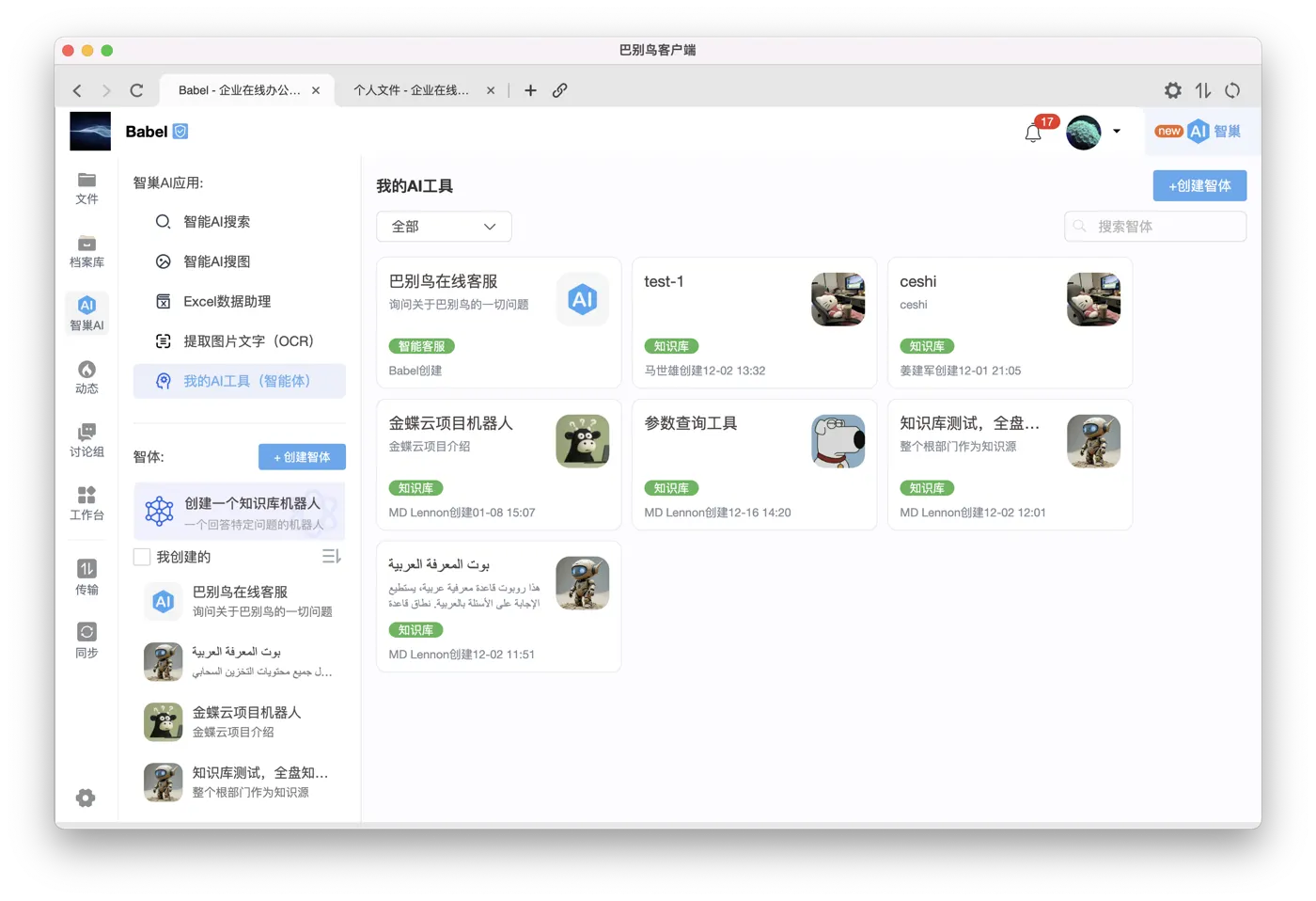
Module Overview
| Module | Main capabilities | Typical scenarios |
|---|---|---|
| AI Search | Learn corporate documents, search and answer questions in natural language, support questioning, source citation, multi-modality and authority judgment | Corporate knowledge query, system query, project data retrieval, technical data Q&A |
| AI Image Search | Search for images in the network disk through text description or uploaded images. The search scope is filtered by permissions | Material library, brand assets, design gallery, image files |
| Intelligent Data Assistant | Analyze Excel/table data, query, analyze, and generate charts across multiple Excel files, and support third-party URL data sources | Sales reports, project ledgers, supply chain data, and operational statistics |
| Customized agent and knowledge base robot | Customized persona, prompt words, response logic, learning folders, industry templates, multi-Agent and website embedding | Enterprise knowledge base, online customer service, industry assistant, internal expert system |
| Enterprise AI Assistant | Integrate most Zhichao applications in a conversational manner, answer corporate document knowledge points, and search network disk files in multiple dimensions | Daily office assistant, file search, cross-data Q&A |
| AI Customer Service | Learn product descriptions, FAQs, customer service documents, and generate intelligent customer service that can provide external services | Official website customer service, product support, pre-sales Q&A, and after-sales knowledge base |
| Standard Edition Modules | Entrance, usage and functional boundaries of 16 standard modules | Administrator selection, implementation scope confirmation, employee training |
| BabelBird MCP | Securely expose files, search, vector knowledge, and image retrieval to external agents | Codex, WorkBuddy, OpenClaw, and enterprise AI integrations |
| AI deployment and customization | Private deployment, dedicated agents, industry applications and development of AI applications according to enterprise processes | Private cloud, dedicated model services, industry solutions |
Standard version module list
The following modules constitute the main functional scope of Zhichao AI Standard Edition. Actual entry and availability may be affected by version, entitlement, and deployment configuration.
| Number | Module | Entry | Function |
|---|---|---|---|
| 1 | Zhichao AI Assistant | Top right AI assistant entrance | Conduct AI conversations based on the enterprise knowledge base, and answer questions in combination with online searches |
| 2 | AI search | Search bar | The search results include AI search content and use natural language to find corporate information |
| 3 | Zhisou | Zhichao AI column | Provides question answering, in-depth research and article writing capabilities |
| 4 | Wensoitu | Zhichao AI Column | Search for pictures in the network disk through text description |
| 5 | Image search | Zhichao AI column, image thumbnail entrance | Match similar images in the network disk by uploading or selecting images |
| 6 | Image OCR | Search, Zhichao AI column | Recognize the text in the image and let the image content participate in the search |
| 7 | Document Assistant | File Preview Interface | Summary, Q&A and reading assistance based on the current document |
| 8 | AI automatic tagging | File list | Match the closest tag in the tag library for the selected document |
| 9 | Table Q&A | Excel file preview interface, Zhichao AI column | Q&A, table generation and function operations based on Excel |
| 10 | Deep thinking | AI assistant, form question and answer, document assistant | Switch to a deeper reasoning mode for complex problems |
| 11 | Internet search | AI assistant | Search Internet content and answer with external knowledge |
| 12 | In-depth research | Intelligent search in the Zhichao AI column | Research-based answers are formed through multiple rounds of search and comprehensive sorting |
| 13 | Enterprise knowledge base | Backend server | Enterprise documents are automatically stored in the database to form a questionable and searchable knowledge base |
| 14 | Knowledge base robot | Zhichao AI column "Create an agent" | Create a customizable agent or knowledge base robot |
| 15 | PDF image search | Search bar | Search image content in PDF documents with images |
| 16 | MCP interface | “API Quick Start” under API Keys | Provide permission-aware knowledge query, search, and file operations to Codex, WorkBuddy, OpenClaw, and other agents |
Core Competencies
- Enterprise-specific AI assistant and AI customer service, which can serve internal employees or external customers through embedded codes.
- AI search and dialogue-based compound query, users can inquire about information, find files, check systems, and check projects just like asking colleagues.
- AI automatic labeling and file classification is used to reduce the cost of manually organizing materials, information and archived documents.
- Customizable AI knowledge base and agents, you can specify learning folders, and you can also configure different assistants for different knowledge areas.
- AI image search, image search, text image search, OCR and multi-modal understanding, used for pictures, materials and scans.
- AI document reading assistant, used to summarize single documents, extract key points, and answer document questions.
- Intelligent data assistant supporting Excel for multi-table cross-analysis, query and chart generation.
- BabelBird MCP exposes files, search, knowledge, and image retrieval to third-party agents while preserving user permissions and folder scope.
- Support on-demand development and privatized deployment, adapting to industry knowledge, enterprise processes and deployment security requirements.
Relationship with enterprise network disk
The value of Zhichao AI comes from the combination of "AI + enterprise file system". Traditional general-purpose chat tools usually don’t know where the company’s internal files are, who has permission to see them, which version is the latest, and which files belong to the same project; Zhichao AI can work around the files, projects, departments, material libraries and permission systems in BabelBird. For businesses, this means that AI doesn’t just answer general knowledge, but can provide help around the company’s own data and business context.
Permission awareness
Zhichao AI's search, question and answer, agents, and knowledge base need to be linked to the BabelBird permission system. What answers a user can get from AI should be limited by the following factors:
- The user's role within the enterprise, department, project, and folder.
- Access control, sharing permissions and validity period for a single file or folder.
- The learning scope specified by the administrator for the agent, knowledge base, or AI assistant.
- Enterprise external sharing, downloading, previewing, watermarking, confidentiality and auditing strategies.
- Configuration strategies for models, indexes, vector libraries and third-party APIs in private deployments.
Knowledge Bases and Models
Knowledge bases parse, index and retrieve selected documents. Uploading files does not inherently fine-tune a model. Agent configuration and specialized model training are different services. Verify sources because answers can contain omissions or errors.
Permissions and usage boundaries
- Zhichao AI's answers, searches, and file references should follow BabelBird's existing permission system. Users can only access content within their account, department, project, share, and file access controls.
- Materials that participate in learning, training, indexing, or Q&A should be designated by the enterprise or administrator; all files should not be considered public knowledge sources by default.
- External customer service, website embedding, third-party data sources, privatized models, and GPU computing power are optional deployment or customization capabilities and should be subject to actual authorization, implementation plan, and enterprise configuration.
- When AI answers involve high-risk content such as contracts, finance, medical care, law, and engineering safety, the AI output should be used as auxiliary information and reviewed by professionals.
Related information
- Permission system
- Security and Audit
- FAQ: Deployment, AI and technical issues
- Public introduction: <https://zhuanlan.zhihu.com/p/2052372550513072059>